
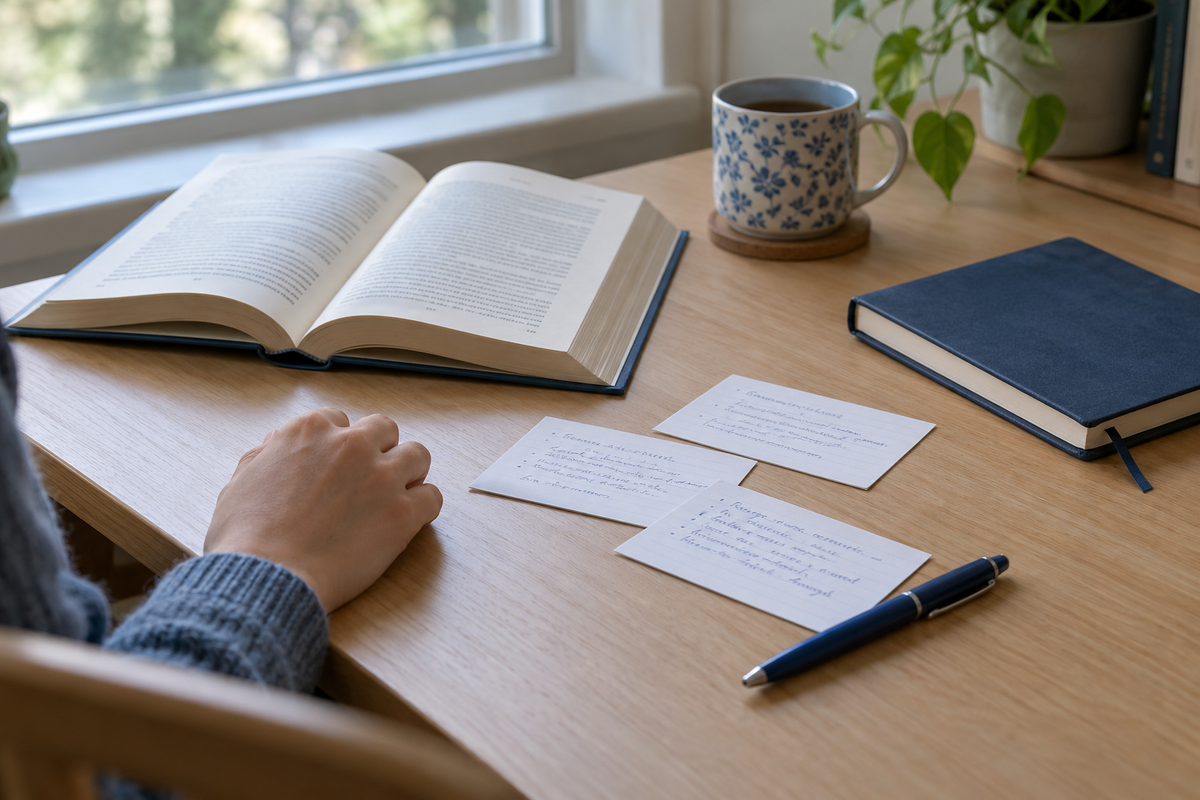
You finish a useful article, recognize every sentence when you glance back, and then struggle to explain its main point at lunch. Reading something that feels familiar and being able to bring it to mind later are different experiences.
One practical response is retrieval practice: try to recall a small amount of information before looking at the source again. You do not need a study app, a stack of perfect flashcards or a longer reading list. Start with one passage you actually want to remember.
What retrieval practice means
Instead of repeatedly reading the same paragraph, close the page and ask yourself a question about it. Say the answer aloud, write a few bullet points or explain the idea in your own words. Then reopen the source and check what you missed.
This is practice, not a performance review. The aim is to make remembering part of the learning process, not to prove that you understood everything on the first attempt.
What the research shows, and what it does not
In two experiments published in 2006, students learned prose passages through repeated study or recall tests. Repeated study performed better on a test just five minutes later, but retrieval practice produced better retention at the two-day and one-week tests. Feeling ready immediately was not the same as remembering later.
A 2011 study by Jeffrey Karpicke and Janell Blunt compared retrieval practice with studying through concept mapping. Retrieval practice benefited later comprehension and inference questions in the science-text learning tasks used in that study.
These are findings about particular learning activities and measured outcomes. They do not establish that every self-quiz works equally well, that concept maps are useless, or that a reading habit treats a memory condition. Neither study tested Focus Fast or any supplement.
Try a read-close-recall-check cycle
- Choose a manageable section. Pick a few paragraphs, a short explanation or one part of a training document. Start small enough that you can identify its main idea.
- Choose a question. Ask something the reading should help you answer: “What problem does this process solve?” or “What are its three important steps?”
- Close or cover the source. Give yourself a brief opportunity to answer without copying. A rough sentence is enough.
- Check against the original. Separate accurate points, missing details and anything you misunderstood. Correct the answer using the source rather than guessing.
- Make one useful prompt for later. Write a question on an index card or in a note. Put the checked answer somewhere you can reveal after trying again.
For a first attempt, spend a few minutes on the cycle. That is a convenient starting point, not a scientifically prescribed dose or a promise of a particular result.
Make questions that require an explanation
“Do I recognize this?” is an easy question to answer while the page is open. A more useful prompt asks you to reconstruct something.
- For a work guide: “Which step comes before the handoff, and why?”
- For a new concept: “How would I explain this to someone who has not read the article?”
- For a comparison: “What is the difference between these two approaches?”
Keep the questions tied to the source. If you cannot check an answer, mark it as uncertain rather than turning it into a confident-looking note.
Return later without turning it into another chore
Try answering the saved question on another day before reopening the reading. Choose a reminder that fits your schedule. The studies above do not provide a universal review calendar for every topic, so treat your timing as a practical experiment.
If you remember almost nothing, use a smaller section or a clearer question. If the answer is easy, try explaining an example or identifying a limitation. Keep checking the source, especially when accuracy matters.
Know when to use a reference instead
Not everything needs to live in memory. For safety procedures, medicine instructions, legal requirements or other consequential details, consult the current authoritative source when you act. Practising recall is not a substitute for a checklist or professional guidance.
For everyday reading, notice whether you can explain the idea accurately later, not how many pages you finished. If memory changes are new, persistent or affecting daily life, seek advice from a qualified health professional instead of treating a study technique as a diagnosis or cure.
Start with your next useful read
Choose one short passage today. Read it, close it, recall the main point and check your answer. The result is a small, repeatable learning activity rather than another collection of highlights you never revisit.
If alerts keep breaking up that reading time, our notification audit addresses the environment around the task. For other practical approaches to attention and organization, explore the Focus Fast journal.